
Partnership is the guiding motif of the World Soundtrack Awards’ Film Music Days, where live performances will give cult films bold new scores and industry mixers encourage emerging composers and filmmakers to find their creative match. To show what such pairings can achieve, two WSA talks will spotlight some of contemporary European cinema’s most enduring and endearing director-composer duos.
Composer Valentin Hadjadj and director Lukas Dhont met as students, an early start that has grown into a collaboration built on a shared creative language.
“Valentin reads the script very early and makes music that resonates with its tonality,” Dhont tells Variety. “Over the years we’ve found our own language, and we do it largely through drawings. I might draw the intention of a scene, like a spiral, or something cruel, harsh and dark, and that visual way of communicating often works best for us.”
Hadjadj, for his part, is especially drawn to the earliest stage of a project.
“Working before the shoot opens up the field of musical possibilities,” the composer explains. “The imagination is more open, so you can try more things, and you’re less constrained by the rhythm of the edit. The music can gain an extra dimension that isn’t obvious the first time you see the film. Once the film exists, its aesthetics and narrative are largely fixed. Whereas I like music to offer another point of view.”
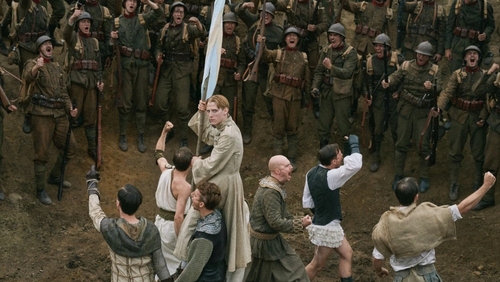
While previous collaborations “Girl” and “Close” featured musical performance, neither did so with the same intensity as in “Coward,” a World War I drama Dhont first pitched to Hadjadj as “a musical about the repression of emotions.”
For the film’s violent scenes, Dhont wanted the score to evoke “the screams of many men,” as if the buried voices of generations past were rising to the surface. The music, he says, needed to become increasingly loud, present and distinct, blurring the line between score and sound design.
Hadjadj arranged archival war songs and revue numbers performed on screen, but he had no interest in making the score a museum piece. He used the period as a starting point, looking past its familiar musical codes toward something more contemporary.
“The easy path would have been broad, sweeping, martial, orchestral music,” he says. “Instead, we took a more pop approach. I looked for textures rather than orchestra, using production instincts from modern pop. Because the film didn’t exist yet, I could work from the story rather than the image. That distance helped make the music more universal, even something that could be transposed to today.”
Composer Volker Bertelmann took a similarly modern approach to the Great War with his reverb-heavy, Oscar-winning score for “All Quiet on the Western Front,” though he arrived at it through a very different process. Now on his sixth project with director Edward Berger, Bertelmann prefers to come in late, working from a nearly finished cut.
“I’m a big fan of not jumping in too early,” says Bertelmann. “I prefer to see something first and then compose to it, getting so deep into the experience that I feel like I’m inside the film, with the story, scenes and characters. I’m constantly shifting into other worlds, putting myself in someone else’s shoes. Sometimes I’m not highlighting what’s on screen, but the mood underneath it, what’s going on inside a character’s head. Music can add that extra layer, like a spice.”
Bertelmann also came to film late, after establishing himself as a recording artist, and that background shapes his process, at times making him feel more like a performer interpreting someone else’s work.
“When I make my own records, nobody tells me what to do, which is wonderful,” he says. “I probably wouldn’t write a very romantic score for myself because I’m more melancholic. I see those records as a mirror of my inner world. With a film, though, there’s a different responsibility. You have to find the right level and nuances to lift things up and make certain moments work.”
That responsibility makes trial and error central to his work with Berger.
“Sometimes you get lucky, and sometimes you both need to experiment,” says the director. “But the comfort of saying ‘can we keep trying?’ or ‘I don’t think it fits yet’ makes the process of exploration much simpler when working with someone whose music you love.”
That partnership continues with “The Riders,” a Brad Pitt-led film set for release next year, on which Berger and Bertelmann are hard at work. The project marks a tonal shift for the longtime collaborators, calling for “fragility and tenderness,” per Berger, and instrumentation that will “express [the lead’s] fragile soul.”
“It’s an inner journey, Brad Pitt’s character’s descent in a way, and then his liberation from whatever is occupying his mind,” says Berger. “So the music should give voice to whatever is driving him, what’s inside of him and his inner nervousness.”
After screening a rough cut, Bertelmann has already returned with 25 themes.
By: Ben Croll






شمـا اولیـن نفـر هستـید کـه نظـر خـود را ثبـت مـی کنیـد.
🗩ثبـت نظر: