
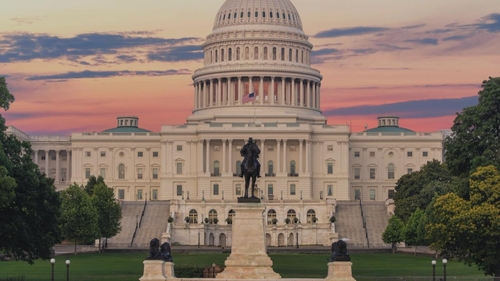
- The U.S. risks losing digital asset business to faster-moving jurisdictions in Asia, the Middle East and Bermuda after the Senate failed to advance the Clarity Act, Apex Group CEO Peter Hughes said.
- Hughes said Europe’s crypto rules remain restrictive, while Saudi Arabia is emerging as a tokenization hub by opening its real estate market to digital assets and greater foreign investment.
- Tokenized money market funds and regulated, yield-bearing stablecoins could accelerate institutional adoption by offering higher returns, collateral utility and broader access than traditional financial products, Hughes said.
The U.S. risks losing digital asset business to Asia and the Middle East if it continues to delay crypto legislation or fails to implement a clear, certain regulatory framework for digital assets, said Peter Hughes, founder and CEO of Apex Group, a global financial firm.
Hughes said, however, that Europe will not benefit from Washington’s setback despite having its own rules in place since July 1.
“I think that the Clarity Act and the delay around that will lead to people finding other solutions elsewhere,” Hughes told CoinDesk in an interview.
Hughes singled out Europe’s Markets in Crypto-Assets Regulation (MiCA), describing it as slow to evolve and restrictive.
“But I do think there's opportunities in Asia, which are moving quickly; the Middle East; even places like Bermuda are moving quickly around having the right regimes to really produce the product for the future, and they'll step into this gap,” he said.
The U.S. Senate last month failed to pass the Clarity Act, which would have established clearer federal rules for digital assets and divided oversight between the Securities and Exchange Commission (SEC) and the Commodity Futures Trading Commission (CFTC). The bill fell short of the 60 votes needed in September after disputes over ethics provisions, stablecoin rewards and other regulatory concerns.
Regulatory uncertainty
The delay leaves uncertainty over how those products will be regulated in the world’s largest economy for companies building blockchain-based financial products.t Hughes believes faster-moving jurisdictions could attract business that might otherwise have gone to the United States.
The SEC and CFTC moved soon after proposing their own set of crypto rules, in an attempt to fill the void left by lawmakers’ failure to reach consensus.
Apex Group, which services more than $3.5 trillion in assets, operates across 50 jurisdictions. Earlier this month, it announced a partnership with droppRWA and Tokeny to help turn real-world assets (RWAs) into regulated blockchain-based investment products, starting in Saudi Arabia.
Faisal Monai, the CEO and founder of tokenization platform droppRWA said Saudi Arabia has already made regulatory changes allowing real estate tokenization and greater foreign participation in its property market. What remains, he said, is infrastructure connecting each digital token directly to the legal record of the underlying asset.
“As long as we can maintain that, then the funds will be able to convey with confidence to their investors that the asset exists, what it’s worth and who owns it,” Monai said.
Hughes also suggested that U.S. banking institutions have influenced the debate around the Clarity and GENIUS acts as they seek to protect their position in the financial system. Banks have raised concerns about stablecoin rewards competing with traditional deposits, although the Senate bill faced significant objections over political ethics and regulatory safeguards.
“The key thing is the scale, and that scale isn't really in these areas,” he said.
Beyond Clarity
Beyond the regulatory debate, Hughes sees tokenized money market funds as one of the biggest drivers of institutional adoption. These funds invest in traditional short-term debt but issue blockchain-based tokens representing investors’ holdings.
Hughes argued that they could compete with bank savings accounts by passing more of the investment returns directly to customers. Hughes cited a comparison of 5% returns from a tokenized money market fund against 3% from a bank savings account. He said the difference in returns could become an important reason for investors to choose tokenized money market funds over traditional bank savings accounts as adoption grows.
Another advantage, according to Hughes, is that tokenized funds can be used as collateral, allowing institutions to borrow against their holdings rather than leaving the money tied up in traditional investment accounts. He said major banks are already examining that use.
Hughes expects regulated, yield-bearing stablecoins to become an important tool for corporate treasuries, provided issuers meet requirements including reserve transparency.
“Whether that happens in one, three, or five years, it's hard to judge,” the Bermuda-based financial firm’s CEO added.
Hughes said he expects tokenization to reach a wider range of investors, including retirement accounts and retail customers, as regulators become more comfortable with the technology. Smaller investment amounts, faster product creation and broader distribution could help bring traditional financial products to people who previously had limited access, he said.
Monai sees a similar opportunity in Saudi Arabia, predicting that tokenization could eventually become a mainstream way for foreign investors to put capital into the country without having to establish local presence.
“I foresee that tokenization will be the mainstream for capital moving into Saudi Arabia,” Monai said.
By: Olivier Acuna






شمـا اولیـن نفـر هستـید کـه نظـر خـود را ثبـت مـی کنیـد.
🗩ثبـت نظر: