
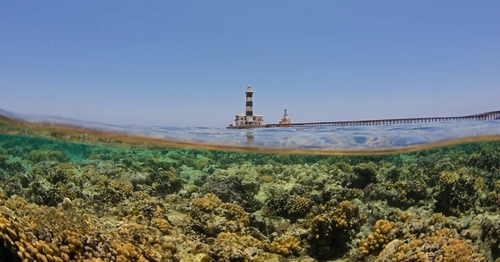
For years, the reefs in Egypt’s Red Sea have been a source of wonder for marine biologists. While coral reefs around the world have been decimated by rising ocean temperatures and acidification, these reefs have remained remarkably resilient, seemingly immune to the bleaching events that have killed off vast swathes of coral elsewhere.
But a growing body of research suggests that even these “super corals” are starting to feel the heat. A new study published in Nature Communications found that while the Red Sea corals are more tolerant to warming temperatures than corals in other regions, they are not invulnerable. The study found that prolonged exposure to high temperatures can still cause bleaching, and that the corals’ ability to recover is limited.
“We’ve been hearing for a long time that the Red Sea corals are somehow special, that they’re resistant to climate change,” says Manuela U. Klaus, a marine biologist at the University of Southern Denmark and lead author of the study. “But our research shows that this is not necessarily true. These corals are more tolerant, but they’re not immune.”
The reason for the Red Sea corals’ resilience has been a subject of debate for years. Some scientists believe that the corals have adapted to the high temperatures and salinity of the Red Sea, while others believe that the corals harbor unique symbiotic algae that are more heat-tolerant. Klaus and her colleagues believe that a combination of factors is at play.
“We think that the Red Sea corals have a combination of genetic adaptations and symbiotic relationships that make them more tolerant to warming temperatures,” Klaus says. “But even these adaptations have their limits.”
The study found that the Red Sea corals began to show signs of bleaching after being exposed to temperatures just 1 degree Celsius above their normal range for several weeks. While this is higher than the temperature threshold for bleaching in other regions, it is still a cause for concern.
“The fact that these corals are bleaching at all is a warning sign,” says Ruth Gates, a coral reef ecologist at the University of Hawaii, who was not involved in the study. “It shows that even the most resilient corals are vulnerable to climate change.”
The findings of the study have important implications for coral reef conservation. If the Red Sea corals are not immune to climate change, then it is even more urgent to reduce greenhouse gas emissions and protect coral reefs from other stressors, such as pollution and overfishing.
“We need to do everything we can to protect these corals,” Klaus says. “They are a valuable resource, and we can’t afford to lose them.”
The researchers are now working to identify the specific genetic adaptations and symbiotic relationships that make the Red Sea corals more tolerant to warming temperatures. This information could be used to develop strategies for helping other coral reefs adapt to climate change.






شمـا اولیـن نفـر هستـید کـه نظـر خـود را ثبـت مـی کنیـد.
🗩ثبـت نظر: